Plain Language Summary
Boswellia is a tree resin sold for joint health. Small human studies suggest that some oral extracts may ease knee osteoarthritis pain, but the studies are too limited to establish it as a treatment. Its role in bowel disease and asthma is even less certain.
What It Is
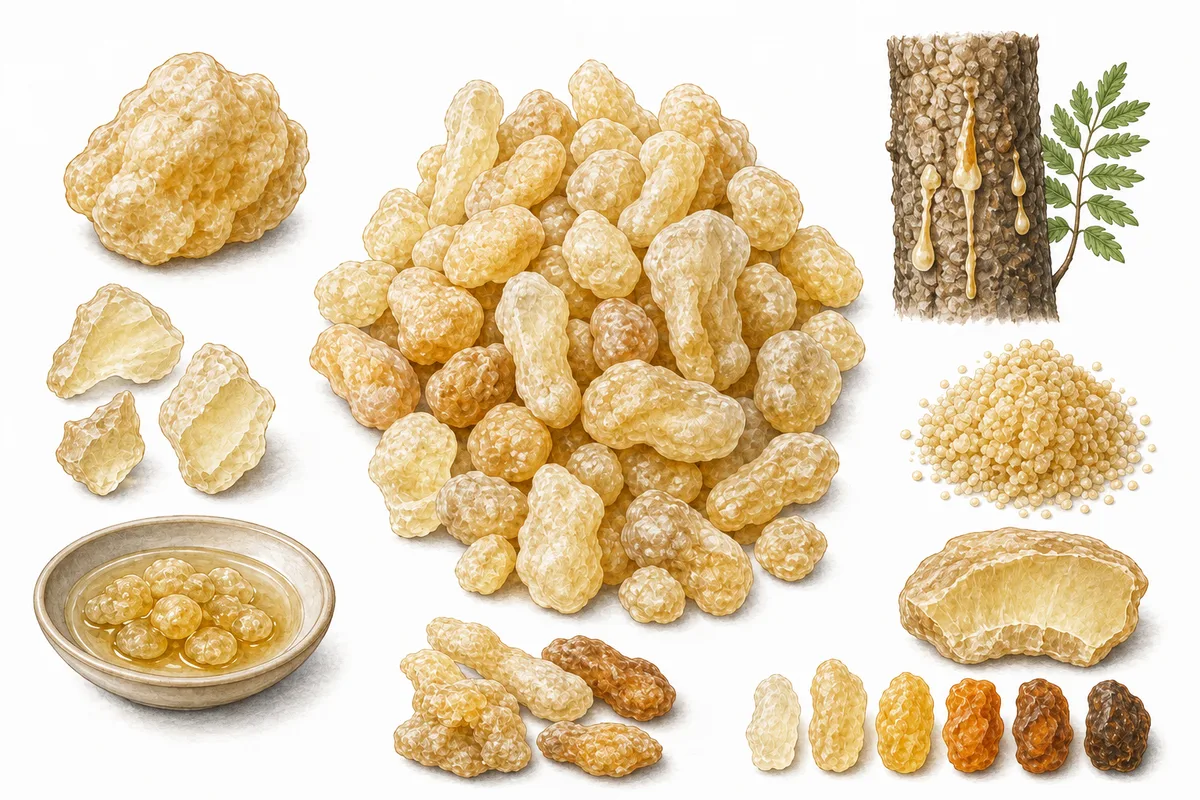
Boswellia serrata grows in India and nearby regions. An extract from its gum resin is sold as a supplement and is sometimes called Indian frankincense. Products vary in how they are made and how much boswellic acid they contain.
Traditional Uses
- Joint discomfort
- Inflammation
- Breathing complaints
- Digestive complaints
Mechanism of Action
Boswellic acids have been studied for effects on inflammatory pathways, including 5-lipoxygenase. A different laboratory mechanism from nonsteroidal anti-inflammatory drugs does not mean boswellia has the same clinical benefit, is safer, or can replace those medicines.
Human Research Highlights
- Several small studies of oral boswellia products report less pain or better function in knee osteoarthritis. Study quality, product differences, and short follow-up limit confidence.
- Evidence for inflammatory bowel disease is too limited to establish benefit or support replacing prescribed treatment.
- A few small asthma studies suggest possible symptom changes, but rigorous evidence is insufficient to determine whether it is useful for asthma.
Preclinical & Laboratory Research
- Laboratory and animal studies show effects on inflammatory pathways. Those findings cannot establish the size of a benefit in people.
- Anti-cancer findings from cell and animal studies do not show that boswellia treats cancer in people.
Dosage Studied
Trials have used different extracts, formulations, and amounts. Their results do not establish one effective or appropriate dose for an individual.
Safety Notes
- Oral boswellia appears reasonably tolerated in short clinical trials, but long-term safety is less certain.
- Limited information is available on medicinal amounts during pregnancy or breastfeeding.
- Report any supplement use to a clinician, especially if you take prescription medicines or are receiving treatment for a chronic condition.
Drug Interactions
- Clinical evidence for specific drug interactions is limited. A pharmacist or clinician should review the exact product with current medicines.
- Do not stop or replace a prescribed anti-inflammatory, asthma, or bowel disease treatment based on a supplement study.
Research Gaps
- Larger, independently replicated trials for knee osteoarthritis with longer follow-up.
- Trials using clearly described, comparable extract formulations.
- Better human evidence for bowel disease and asthma.
- Long-term safety and interaction data.
Clinical Relevance
The most useful human signal concerns knee osteoarthritis symptoms, and even there the studies are mostly small or low quality. The NIH National Center for Complementary and Integrative Health says there is not enough high-quality evidence to determine whether boswellia is useful for any health condition. It should be discussed as a possible adjunct, not an established substitute.
Citations
- NIH National Center for Complementary and Integrative Health. Boswellia: Usefulness and Safety. Updated April 2025. Read source
- Bannuru RR et al. Efficacy of curcumin and Boswellia for knee osteoarthritis: Systematic review and meta-analysis. Seminars in Arthritis and Rheumatism. 2018. Read source
Disclaimer: Educational information only. Not medical advice. Consult a qualified healthcare professional before use.
Last updated: September 23, 2026